Systems
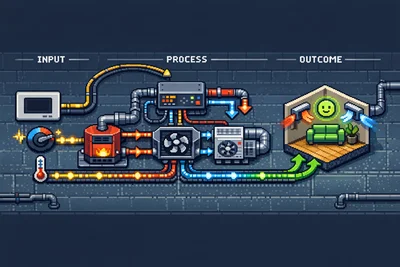
You watch a thermostat click on. The room warms. It clicks off. Something just made a decision without you.
Here's what most people miss: that moment—input, process, output, feedback—is the same logic keeping your heart beating, running the stock market, and powering the AI reading this sentence. Every complex thing you've ever interacted with follows the same invisible pattern.
There's a lens that reveals how your body regulates its own temperature, how databases maintain data integrity, and why removing wolves from Yellowstone caused rivers to change course. Once you see it, you can't unsee it. Systems thinkers don't just solve problems—they understand why problems exist in the first place.
You're about to discover why engineers, biologists, economists, and designers all speak the same underlying language—and why learning it changes how you see everything.
Recent Posts
Cloud Insurance: Archera Explained
Archera.ai invented cloud commitment insurance. Nobody understands what that means. Here's the analogy guide that finally made it click.
Read more →How To Teach AI Habits — And Stop Repeating Yourself
Build an external memory for your AI workflows. These principles separate chat users from operators who ship.
Read more →Top 10 Systems Questions
Beginner Learners
What exactly is a "system"?
A system is a set of interacting components that form a complex whole with a specific purpose. Your body, your phone, and your city's traffic grid are all systems. Every system has three things: components, interconnections, and a purpose.
Why should I care about systems thinking?
Because most problems you face aren't isolated—they're connected. Fixing one thing often breaks another. Systems thinking helps you see the full picture and find solutions that actually work long-term.
What's a feedback loop?
A cause-effect chain is linear: A causes B causes C. A feedback loop is circular: A affects B, B affects C, and C loops back to affect A. Feedback loops are what make systems self-regulating.
How do biological and tech systems compare?
Surprisingly similar. Your body uses hormones as signals; computers use electrical pulses. Both maintain stability through feedback. The main difference is biological systems evolved; technological systems are designed.
Intermediate Learners
What makes a system "complex" vs. "complicated"?
Complicated systems have many parts but are predictable (like a car engine). Complex systems have parts that interact unpredictably, creating emergent behavior you can't predict from the parts alone.
Negative vs. positive feedback loops?
Negative feedback stabilizes—your AC kicks on when hot, off when cool. Positive feedback amplifies—a microphone near a speaker creates a screech. Your body uses negative feedback for homeostasis.
What is "emergence"?
Emergence is when a system exhibits properties that none of its individual parts possess. A single neuron can't think, but billions together create consciousness. That's why reductionism fails.
Advanced Learners
How do bounded contexts work in software?
Bounded contexts are isolated parts of a system with clear boundaries, each with its own internal model. They're a Domain-Driven Design concept that prevents complexity from bleeding between components.
What's entropy's role in system maintenance?
Systems naturally tend toward disorder (entropy). Maintaining a system requires continuous energy input—updating software, repairing machinery, or eating food. That's why abandoned codebases become debt nightmares.
How do cybernetics apply to modern AI?
Modern AI systems are cybernetic machines—they use feedback (training loss) to adjust their internal state (weights) toward a goal. The same control theory that guided WWII missiles now powers language models.
The Science of Systems
37 Trillion Cells in Sync
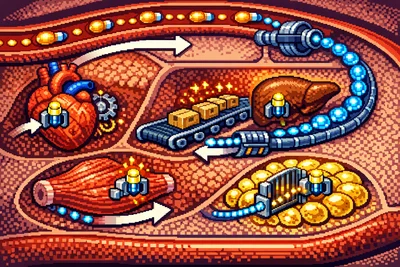
Every cell in your body communicates through chemical and electrical signals. When even one feedback loop fails—like insulin signaling—the entire organism destabilizes. You're a civilization.
Born from Anti-Aircraft Guns
Norbert Wiener developed the first cybernetic system during WWII to predict enemy aircraft trajectories. The same feedback principles now power thermostats, autopilots, and your AI assistant.
Wolves Changed River Courses
When wolves were reintroduced to Yellowstone, elk stopped overgrazing riverbanks. Vegetation returned, stabilizing soil. Rivers literally changed their paths—a textbook cascading system effect.
The "Great Forgetting"
By the 1960s, cybernetics essentially disappeared from public discourse, rebranding itself as "AI," "machine learning," and "data science." The philosophy never vanished—it got new marketing.
Your Thermostat is Smart
Modern car engines use real-time oxygen sensor feedback to adjust fuel injection hundreds of times per second. This closed-loop system optimizes combustion better than any human could.
Catastrophic Positive Feedback
Permafrost thawing releases methane, which warms the planet, which thaws more permafrost. This self-amplifying loop is why scientists talk about "tipping points"—once triggered, it accelerates.
All Systems Follow One Pattern
Whether it's kidneys filtering blood, a database handling queries, or an OS managing memory, everything follows Input → Process → Output → Feedback. That's why systems theory works everywhere.
The Whole Beats the Sum
Individual neurons can't think. Individual transistors can't compute. Individual traders can't create a market. But put enough together with the right connections, and something new emerges.
Analysis Paralysis
Systems thinking can become an excuse for endless complexity mapping instead of taking action. Set time limits for analysis. Focus on finding the 20% of elements that drive 80% of outcomes (leverage points).
Why People Stay for Decades
Pioneers of Systems Theory
"A system is an interconnected set of elements that is coherently organized in a way that achieves something... A system must consist of three kinds of things: elements, interconnections, and a function or purpose."
"The whole is more than the sum of its parts." — His foundational insight that systems exhibit emergent properties that cannot be predicted from individual components alone.
"We have decided to call the entire field of control and communication theory, whether in the machine or in the animal, by the name Cybernetics."
"The systems viewpoint is generally oriented toward the long-term view. That's why delays and feedback loops are so important. In the short term, you can often ignore them."
The Top Reasons
- 🧠 See What Others Miss — Systems thinkers see patterns and connections invisible to linear thinkers—they understand why "solutions" often backfire
- 🔧 Fix Problems at Root — Instead of treating symptoms, you learn to identify leverage points where small changes create large effects
- 🌍 Universal Applicability — The same principles apply to biology, software, economics, design—learn once, apply everywhere
- 💡 Anticipate Consequences — Understanding feedback loops lets you predict how interventions will ripple through a system before acting
- 🏛️ Design Better Systems — Whether building software, organizations, or habits, systems thinking produces more robust and adaptive designs
- ⏰ Future-Proof Thinking — In an increasingly interconnected world, systems literacy is becoming as essential as traditional literacy
- 🎯 Find Leverage Points — The ability to identify where small inputs yield disproportionate outputs is the highest-value skill in complex environments
- 🤝 Bridge Disciplines — Doctors, engineers, economists, and designers can all speak the common language of systems—enabling unprecedented collaboration
From the Community
"Once I started seeing feedback loops, I couldn't unsee them. Traffic jams, office politics, my own procrastination—they're all systems with the same dynamics."
"I went from 'why does everything break?' to 'of course it breaks—there's no feedback mechanism.' Systems thinking changed my engineering career."
"The moment I understood emergence, I stopped trying to micromanage my team. Complex behavior emerges from simple rules, not detailed instructions."
"Systems thinking ruined me in the best way. I can't watch the news without drawing feedback loops on a napkin."