
Nutrition
Your brain runs on fuel. Your mitochondria produce energy from what you eat. But what happens when you've been filling the tank with cheap gasoline for years?
Here's the truth nobody wants to admit: most nutrition advice is backwards. We're told to count calories, avoid fats, eat less — while the real enemy hides in plain sight. The foods making you tired, inflamed, and foggy aren't on anyone's "avoid" list. They're in your pantry right now.
What if the answer isn't about eating less, but eating differently? What if your brain literally runs on what you put in your mouth — and you've been running it on the wrong fuel?
The people who understand this look different. They think clearer. They recover faster. And they've discovered that nutrition isn't about restriction — it's about feeding a system that's been starving for the right inputs.
You're about to learn how that system actually works. And once you do, you won't look at food the same way again.
Recent Posts
Top 10 Nutrition Questions
Beginner
What should I actually eat for energy?
Focus on whole foods: quality proteins (eggs, fish, meat), healthy fats (olive oil, avocado, nuts), and complex carbs (vegetables, berries). Your cells make energy from these macronutrients — garbage in means garbage out.
Is breakfast really the most important meal?
Not necessarily. Your body can run perfectly fine without breakfast — many people thrive on time-restricted eating (16:8). What matters more than when you eat is what you eat when you do.
How much water do I actually need?
About 0.5-1 oz per pound of body weight daily, more if active. But don't forget electrolytes (sodium, potassium, magnesium) — water without minerals is only half the equation.
Are carbs bad for me?
No — but refined carbs are. Your brain's preferred fuel is glucose. The problem is sugar and processed carbs that spike insulin and cause crashes. Whole food carbs are fine.
Intermediate
What's happening when I feel an "energy crash"?
Your blood sugar spiked from refined carbs, insulin responded, and now glucose is being stored rather than used. Your cells are temporarily starving. Stable energy requires stable blood sugar.
Should I worry about my gut microbiome?
Yes. Your gut bacteria produce vitamins (B vitamins, K2), short-chain fatty acids for energy, and neurotransmitters (95% of serotonin). An unhealthy microbiome = nutrient deficiencies even with perfect food.
Is intermittent fasting actually beneficial?
For most people, yes. Fasting triggers autophagy (cellular cleanup), improves insulin sensitivity, and gives your gut a rest. 16:8 is the most sustainable approach. But listen to your body.
Advanced
Why do some people thrive on carnivore without fiber?
Ketones (especially beta-hydroxybutyrate) can substitute for butyrate as fuel for colon cells. The microbiome adapts to ferment amino acids. And for people with gut damage, removing plant irritants allows healing.
How does mental state affect energy production?
Directly. Chronic stress fragments mitochondria (your cellular power plants), reducing ATP output. Positive psychological states are associated with more mitochondria and better energy production.
What's the connection between nutrition and aging?
Mitochondrial efficiency declines with age, but much of what we call "aging" is metabolic dysfunction from poor diet. Hormetic stressors (fasting, cold exposure) trigger repair mechanisms.
The Science of Nutrition
Your Brain is 60% Fat
Your brain runs on fat and glucose, not willpower. DHA (omega-3) is essential for neuron membranes. People on low-fat diets often experience brain fog.
30-32 ATP Per Glucose
Every glucose molecule becomes ~32 units of ATP (cellular energy) through the electron transport chain. This requires oxygen, magnesium, and B vitamins.
38 Trillion Co-Pilots
Your gut contains 38 trillion microorganisms — more than your human cells. They produce vitamins, break down fiber, and manufacture 95% of your serotonin.
Ketones: Ancient Brain Fuel
When carbs are low, your liver produces ketones from fat. Your brain can run 70% on ketones — and some neurons prefer them. Evolution's famine adaptation.
Meat Made Us Human
The "Expensive Tissue Hypothesis": as early humans ate more meat, their guts shrank and their brains grew. The brain expansion 2 million years ago coincides with increased meat consumption.
Plants Fight Back
Lectins, oxalates, phytates — plants can't run away, so they evolved chemical defenses. For those with gut issues, these "antinutrients" can cause inflammation.
Electrolytes > Water
You can drink plenty of water and still be functionally dehydrated. Sodium, potassium, and magnesium create the electrochemical gradients that power every cell.
The Bear Diet
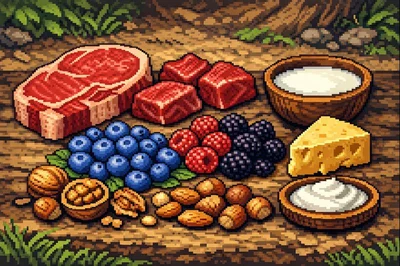
Bears are true omnivores — berries, fish, eggs, and meat depending on season. My approach: beef, berries, nuts. No refined carbs, no processed foods.
Elimination Diet Caution
Carnivore and keto diets can cause nutrient deficiencies if done incorrectly — especially Vitamin C without organ meats. Electrolyte imbalances are common during adaptation. Include organ meats and supplement electrolytes during transition.
Why People Optimize for Decades
"Let food be thy medicine and medicine be thy food."— Hippocrates, Ancient Greek Physician
"Eat food. Not too much. Mostly plants."— Michael Pollan, Author
"For many people, the simplest path to health is to eat meat and drink water."— Shawn Baker, MD
"Diet changes gene expression, mitochondrial function, and brain metabolism. Food is literally building and running your brain."— Dr. Chris Palmer, Harvard Psychiatrist
Top Reasons People Stay
What People Say
"I spent 20 years following 'expert advice' and feeling terrible. Two months of eating actual food and I have more energy than I did at 25."
"Once I understood that my mitochondria are literally the engines running my life, everything clicked. You can't run a Ferrari on low-grade fuel."
"The carnivore diet saved my gut after years of IBD. Doctors said I'd be on medication forever. Three months of meat and water and I'm symptom-free."
"I stopped asking 'what should I eat?' and started asking 'what is my body actually doing with this?' Game changer."
This isn't nutrition advice. It's one person's framework for understanding how food affects the body. Your system is unique — observe, experiment, and find what works for you.