Markets
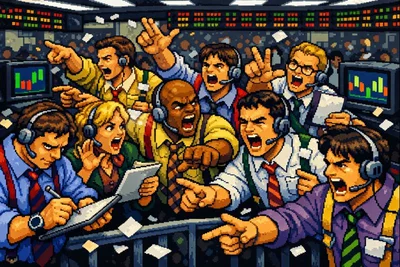
You watch the ticker. You read the headlines. You know something is happening in those numbers—some pattern just beyond your grasp, some edge waiting to be found.
The pull isn't really about money. It's about the puzzle. About reading human behavior at scale. About developing the discipline to do the opposite of what feels natural—cut losses quickly, let winners run, stay still when every instinct screams to act.
Markets are the ultimate game: no final boss, no endpoint, just continuous evolution. The rules change. The players adapt. And the person you compete against most fiercely? That's you—yesterday's version of you, making the same mistakes you haven't yet learned to avoid.
What follows is what I've learned—from books, from mentors, and mostly from losses that taught me lessons I couldn't learn any other way.
Recent Posts
Top 10 Trading Questions
Beginner Traders
What is swing trading and is it suitable for beginners?
Swing trading means holding positions for days to weeks to profit from short-to-medium-term price movements. It's less intensive than day trading—only 15-30 minutes daily—making it ideal for those with full-time jobs. Start with $2,000-$5,000 minimum.
How do I build a swing trading watchlist?
Focus on liquid stocks in uptrends (10-day and 20-day EMAs above 200-day MA), with volume above 500,000 shares daily and clear support/resistance levels. Maintain 5-12 stocks to focus on quality setups rather than overwhelm.
What indicators should beginners use?
Start with Moving Averages (50-day and 200-day for trend), RSI (below 30 = oversold, above 70 = overbought), and volume. High volume during breakouts confirms validity. Keep it simple—complexity comes later.
How do I set an effective stop-loss?
Never risk more than 1-2% of your account per trade. Place stops below key support levels. The "Golden Rule": once set, never move your stop-loss down—only up to lock in profits as the trade works.
Intermediate Traders
How do I identify high-probability entry points?
Enter during pullbacks to moving averages within established trends, or on breakouts from consolidation zones with high volume. Use confluence—multiple indicators agreeing (MA crossover + RSI recovery + volume spike) creates the best entries.
What exit strategies actually work?
Set profit targets before entering (3-5% for conservative traders). Use trailing stops that move up as price advances. Aim for 1:2 or 1:3 risk-reward ratios. Scale out—sell portions at milestones to lock in gains.
How do I adapt to different market conditions?
Bull markets: buy breakouts and pullbacks aggressively. Bear markets: reduce position sizes by 50%+, raise cash to 50-70%. Choppy markets: avoid breakouts (they fail frequently), focus on range-trading, or sit in cash.
Advanced Traders
How do I use sector rotation in swing trading?
Monitor relative strength to identify which sectors are leading vs. lagging. Overweight technology and consumer cyclicals in early expansion phases. Rotate to healthcare and utilities during market tops.
What role does market regime identification play?
Identify Bull, Bear, or Sideways regimes using: SPY/QQQ position relative to 200-day MA, VIX levels (under 20 = calm, over 30 = fear), and market breadth. Different regimes require completely different playbooks.
How do I incorporate macro analysis?
Watch credit spreads (HYG/LQD widening = risk-off brewing), VIX term structure (backwardation = acute fear), and yield curve inversions (2Y > 10Y = recession signal). These lead equity signals by weeks or months.
The Market's Hidden History
The First IPO
In August 1602, the Dutch East India Company (VOC) launched history's first public stock offering. Over 1,100 investors—including a maid who invested 100 guilders—raised 6.5 million guilders. This single event created the Amsterdam Stock Exchange.
Dividends in Spices
When VOC shareholders demanded returns in 1610, the cash-strapped company paid dividends in mace spices at 75% of capital value. Over 200 years, dividends averaged 18% annually—sometimes hitting 40%.
First Corporate Nation
The VOC wasn't just a company—it could wage war, mint currency, negotiate treaties, and execute prisoners. It was a nation-state disguised as a trading company.
Ancient Financial Innovation
By 1688, sophisticated instruments existed: derivatives, short selling, margin trading. Joseph de la Vega documented these "modern" practices 330+ years ago. Nothing is new in markets.
The Psychology Factory
Markets are 80% psychology, 20% skill. Fear, greed, FOMO, revenge trading—every emotional trap is baked into price action. The market is a mirror: it shows exactly who you are under pressure.
First Crash
The VOC was involved in what historians consider the first modern stock market crash, demonstrating that market dynamics—bubbles, panics, greed cycles—haven't fundamentally changed in 400 years.
Millisecond Markets
By 2009, over 60% of U.S. trades were executed by computers. Today, algorithms execute thousands of trades per second. The speed changed—the human psychology driving markets hasn't.
Democratized Access
Pre-1990s, trading required brokers, high commissions, and significant capital. Today, anyone with $100 and a phone can access global markets. The barrier shifted from capital to discipline.
The Greed Trap
Trading profits can trigger dopamine responses similar to gambling addiction. Overconfidence after wins leads to oversized positions and rule-breaking. 90% of retail traders lose money—often because they keep trading after they should have stopped. Set strict loss limits, take mandatory breaks, and journal every trade including your emotional state.
Why People Stay for Decades
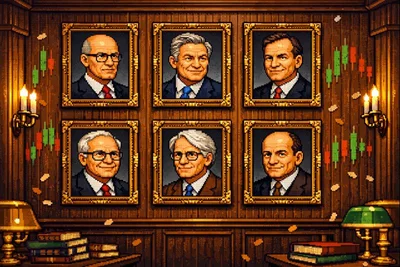
"Be fearful when others are greedy, and greedy when others are fearful."
— Warren Buffett
"Know what you own, and know why you own it."
— Peter Lynch
"Markets are constantly in a state of uncertainty and flux, and money is made by discounting the obvious and betting on the unexpected."
— George Soros
"In the short run, the market is a voting machine but in the long run, it is a weighing machine."
— Benjamin Graham
Top Reasons
Intellectual Challenge
The market is an infinite puzzle. Just when you think you understand it, conditions change—forcing continuous learning.
Financial Freedom
Breaking free from the 9-to-5. Building wealth that works while you sleep. Living life on your own terms.
Meritocracy
Markets don't care about credentials, connections, or background. Results speak. The scoreboard is updated daily.
Pattern Recognition
Reading human behavior at scale through price and volume. Finding order in apparent chaos.
Self-Mastery
Trading forces you to confront every psychological weakness: fear, greed, impatience, revenge, overconfidence.
Global Awareness
Understanding macro, Fed policy, sector rotations connects you to the world economy like few other activities can.
Time Flexibility
Trade when markets are open, analyze on your schedule. No boss approval needed. From anywhere with internet access.
Compounding
Small edges, repeated consistently over years, compound into significant results. Patience and discipline above all.
From the Community
"I've been trading for 12 years. The first 3 years I lost money learning what doesn't work. Years 4-7 I broke even learning discipline. Years 8+ I became consistently profitable. Most people quit during year 2."
"The market humbled me completely in 2020. I thought I knew everything. Now I size small, respect stops, and treat every trade like it could be wrong. That mindset shift changed everything."
"It's not about being right. It's about managing risk when you're wrong and maximizing exposure when you're right. That took me five years to truly understand."
"Trading taught me more about myself than 10 years of therapy. Every emotional pattern I have shows up in my P&L. You can't hide from yourself in this game."